How do I know if a SIP trunk has stopped completing calls?
The direct way is to call it. Monitor places a real test call to each voice circuit (SIP trunk, branch extension, or contact center number) at the agreed pace and checks three things: whether the call connected, whether audio flowed both ways, and whether the voice sounded clear. When any of them fails and the failure is confirmed, your team gets the alert with the SIP code as proof.
Conventional monitoring asks the equipment whether it is up. The PBX says yes, the trunk shows as registered, and the network is green, while callers hear silence. A real call does not depend on what the equipment says about itself.
What does each test call check?
| Check | What counts as a failure |
|---|---|
| The call connects | A carrier rejection (for example SIP 403, 404, 480, or 503), or no response at all |
| The right thing answers | The expected greeting, test tone, or echo service does not answer |
| Audio both ways | One-way audio or no audio (a silent call) |
| Voice quality | Measured MOS-LQO below the agreed threshold: the call counts as degraded |
How does Monitor avoid false alarms?
A failed call is retried at your pace. Only consecutive failures, four by default (the first plus three retries), open an incident. A one-minute blip does not wake anyone up in the middle of the night, and an alert at 2 a.m. is always real.
If the problem is on 2N5’s side, for example 2N5’s call server not responding, the test is marked blind: it does not count against the trunk, does not go into the SLA, and does not notify the customer. Maintenance windows silence alerts while the carrier or your team works on the circuit.
What evidence goes to the carrier?
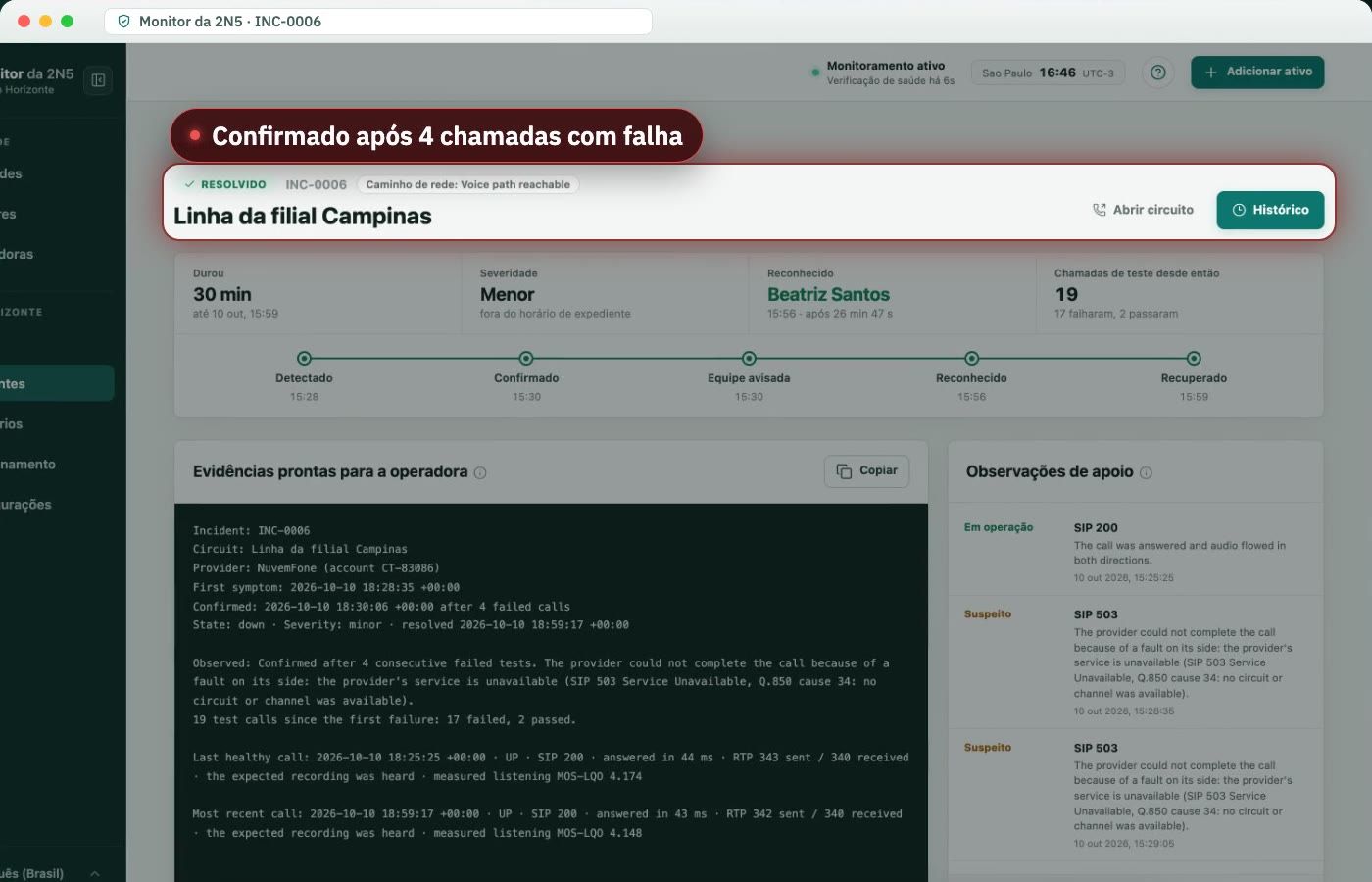
Each incident includes a block ready to paste into the ticket: the circuit, the carrier, the first symptom, the SIP code and Q.850 cause of every call, and the last healthy call. It is the answer to “no fault found”: the time, the number called, and what the route returned.
Sample evidence, with demo data: SIP 503 Service Unavailable, Q.850 cause 34 (no circuit/channel available), confirmed after 4 failed calls.
Who gets notified, and how?
Your company’s escalation ladder, by email and SMS, one tier at a time, until someone acknowledges the incident with a tap on their phone. See alerts and escalation.
Frequently asked questions
Does Monitor need access to my PBX or my SBC?
No. 2N5 places the test calls from its own platform to the numbers you specify, just as anyone would. Nothing is installed on your PBX, your SBC, or your voice network.
How often is each trunk tested?
At the pace agreed with you, for example every 15 minutes, or at fixed times. A failed call is retried before any alert, and only consecutive failures open an incident.
Do the test calls take up channels on my trunk?
Each test is a short call to a number you choose, within a call limit. It holds one channel for a few seconds, like a customer call, and never touches your customers' calls.
Does it work with any carrier?
Yes. The test dials the number, so it works with SIP and E1 trunks from any carrier and with any PBX. The result includes the SIP code and the Q.850 cause the route returned.
What happens when the fault is on 2N5's side?
The test is marked as blind, never as a failure of your trunk. It does not count against your SLA and does not wake anyone on your team; 2N5 is notified if it lasts more than 30 minutes.