How do you measure the voice quality of a SIP trunk or an 0800 number?
By listening to a real call. Monitor records the audio the test call received and compares it with the expected recording (your IVR greeting or the test tone) using a perceptual model that gives a score from 1 to 5, the MOS-LQO. It measures what a customer would hear, not a calculation made from network figures.
Measured or estimated: what’s the difference?
| Estimated MOS (E-model) | Measured MOS-LQO (Monitor) | |
|---|---|---|
| Where it comes from | Packet loss, jitter, and delay reported by the network | The audio the call received, compared with the reference |
| Standard | ITU-T G.107 (R-factor) | ITU-T P.800.1 terminology; ViSQOL model |
| Sees audio cut at the source | No | Yes |
| Sees a wrong message | No | Yes: the comparison with the reference fails |
Both measures have their place. A network estimate is useful for looking at the network; a call that is actually listened to tells you whether the voice got through.
What is a good score?
The MOS scale runs from 1 (bad) to 5 (excellent), as in ITU-T P.800. In practice, around 4 the voice sounds clear, and below 3 people start to complain. Monitor’s default thresholds are:
| Range | Reading |
|---|---|
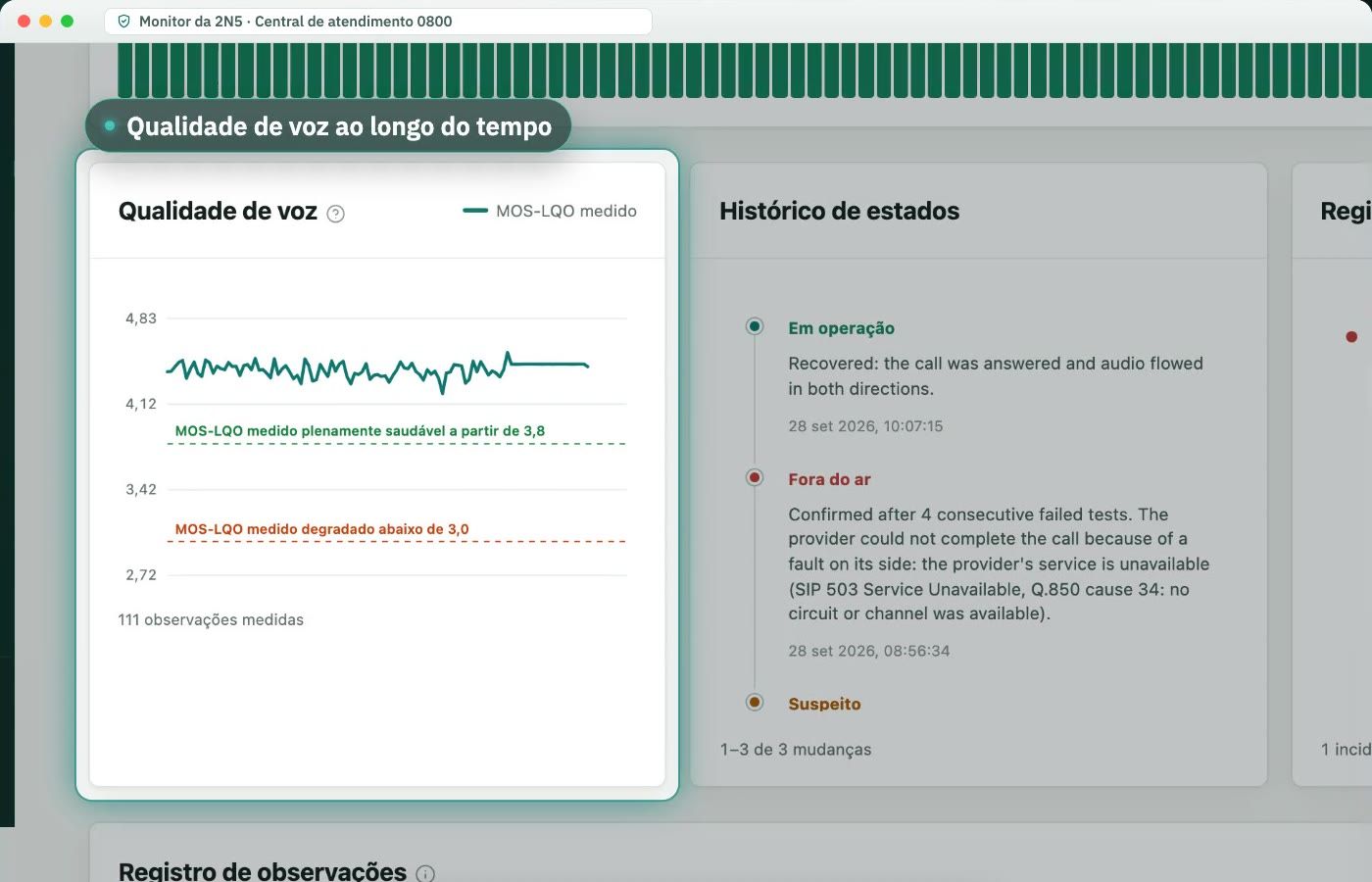
| 3.8 or higher | Healthy |
| From 3.0 to 3.8 | Working, with the score flagged as below ideal |
| Below 3.0 | Degraded: the test call counts as degraded |
Where does quality show up?
On each circuit’s page, with the score of every test call and the threshold lines; on the dashboard next to the circuit’s status; and in the SLA reports. A drop below the threshold goes through the same retries as any failure before it becomes an alert.
Why is the reference recording needed?
Because a perceptual model compares two signals: what should have been heard and what was heard. During onboarding, 2N5 records the reference for each number. The stored audio is that of the recording or the IVR, never a person’s voice, and it is deleted after 90 days.
Frequently asked questions
What is MOS-LQO?
It is a listening quality score from 1 to 5, calculated by an objective model from the received audio. LQO stands for "listening quality objective", in ITU-T P.800.1 terminology. Around 4 the voice sounds clear; below 3, people complain.
How is it different from the MOS my PBX shows?
Many devices estimate the score from network figures, such as packet loss and jitter, using the ITU-T G.107 E-model. Monitor does not estimate; it listens to the audio that arrived and compares it with the reference recording.
Which measurement model do you use?
ViSQOL, an open perceptual quality model published by Google Research, in speech mode. It compares the received audio with the reference audio and returns a score on the MOS scale.
What are the thresholds?
By default, a circuit is healthy at a MOS-LQO of 3.8 or higher and degraded below 3.0. 2N5 tunes the thresholds with you, per circuit, during onboarding.
What happens when quality drops?
A score below the threshold marks the test call as degraded, and it goes through the same retries as any failure. If it persists, a quality incident opens and the escalation ladder is notified.