How do I produce a telephony SLA report by month and by year?
By measuring every circuit all the time and adding it up. Because Monitor calls each voice circuit at the agreed pace, it knows when each one was down and for how long. Every month it builds the service report with the availability for the period and the last 12 months, and emails it to the people you chose.
What is in the report?
| Section | What it shows |
|---|---|
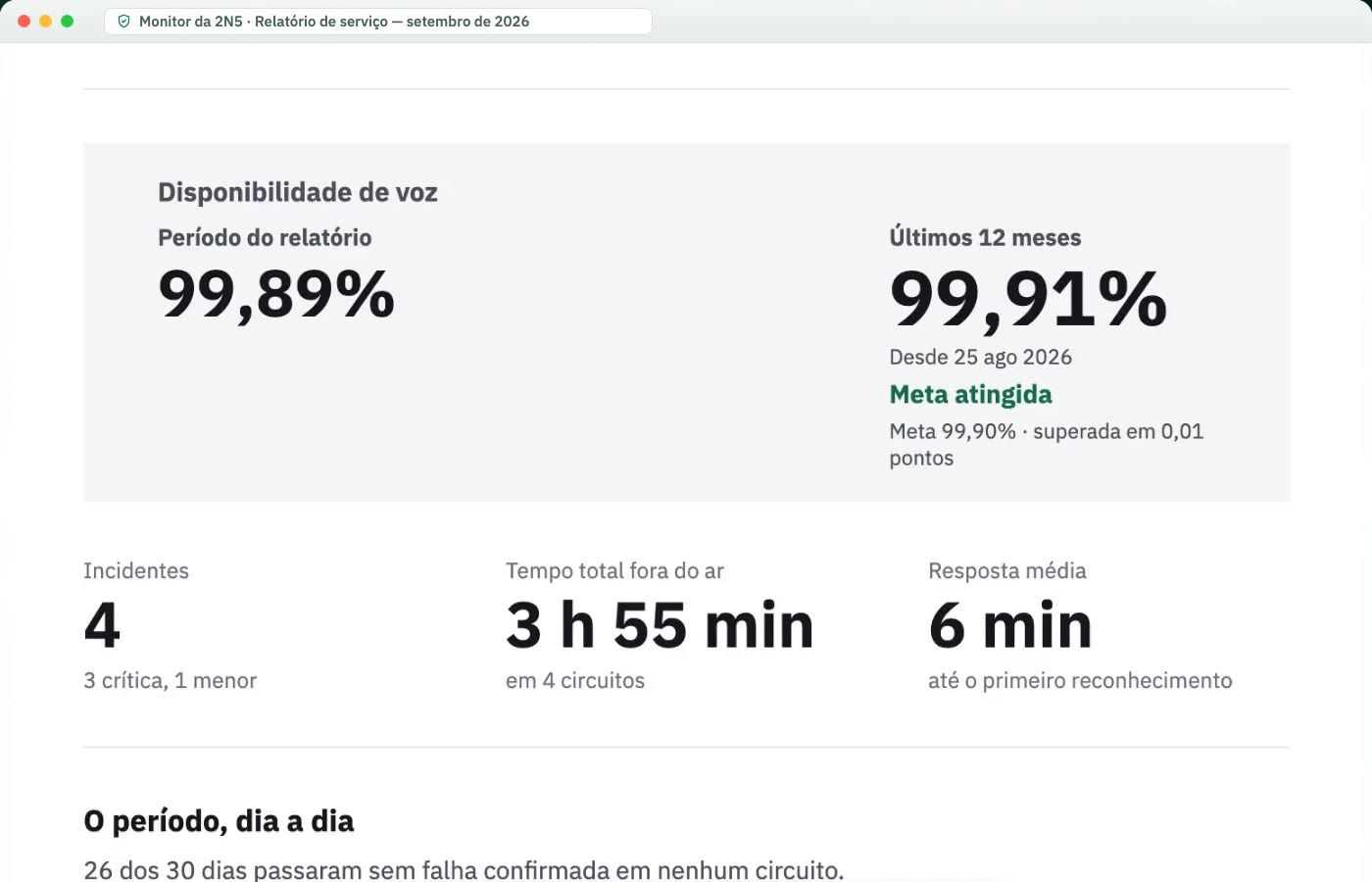
| Voice availability | The report period and the last 12 months, against the contract target |
| Incidents | How many, at what severity, and how long each one lasted |
| Downtime | The total for the period, per circuit |
| Average response | The time to first acknowledgment of each incident |
| The period, day by day | Which days had a confirmed failure on some circuit |
| By circuit and by carrier | The availability of each circuit and each carrier |
Example with demo data: 99.89% availability for the month and 99.91% over the last 12 months, 99.90% target met, 4 incidents, 3 h 55 min of downtime, and an average of 6 minutes to first acknowledgment.
How much downtime fits in 99.9%?
In a 365-day year, 99.9% availability allows about 8 hours and 46 minutes of downtime; 99.95%, about 4 hours and 23 minutes; 99.99%, about 53 minutes. In a 30-day month, 99.9% allows about 43 minutes. The math is always the same: the length of the period multiplied by (100% minus the target). The SLA calculator does the math for any target and period, and the guide Telephony SLA: yearly and monthly calculation explains what counts as an outage.
What is left out of the calculation?
The periods when the monitoring itself was blind because of a problem on 2N5’s side. They are taken out of the calculation and shown separately, because monitoring blindness is not an outage of your circuit, and an honest SLA figure cannot mix the two.
Frequently asked questions
Why does the report show the last 12 months?
Because in Brazil the telephony SLA is usually measured over the year. The 12-month figure is what decides whether the target was met; the month and the last 30 days are shown for reference.
Who receives the report?
The people your company chooses, by email, each in their own language, English or Portuguese. A branch manager can receive only the report for their part of the organization.
Does a monitoring failure count against me?
No. A period when 2N5 could not test the circuit because of a problem on 2N5's side is left out of the calculation and shown separately. Monitoring blindness never becomes downtime for your circuit.
Does the report work as evidence for the carrier?
It lists every incident with start, end, and duration, and each incident carries the SIP codes and Q.850 causes of the test calls. It is the record that is usually missing when the carrier says it found no fault.